
Before the phone screen
Hear your candidates think
Candidates answer a real question for your role in a short video, before the first call.
Get started for free
No credit card required
Take the tour
Hiring? Paste any job description. We’ll build a sample McCoy IQ challenge for that role and walk you through what it would look like. Just for you. No account required.
Paste one of your job postings below to take the tour with your own role. No signup required.
When you’re ready to try it on a real role, it’s free and no ATS integration is required.
Looking for a job? Try the McCoy app instead
Building your preview
One moment…
- Reading the job description
- Finding the company
- Extracting your branding
- Understanding the role
- Drafting a challenge question
- Setting up your preview
Imani T.
Arjun S.
Robert H.
Sofia R.
Kevin L.
Claire M.
The platform
Save time
before the interview
Give candidates a real problem they’d face on the job, or your favorite open-ended interview question. Start with what you think matters most for the role. Hearing candidates answer helps you test that thinking before you spend hours in interviews.
Tell McCoy about your role
Start with a job description
Describe the role and pick the challenge question, or start from your job posting and McCoy drafts the whole thing in one shot.
Make it yours
Branding, plus a recorded or AI avatar intro
McCoy drafts the page. Record a quick intro yourself or let an AI avatar deliver it, then add your branding.
Publish in minutes
One link to share
Your challenge page goes live, ready to share with candidates.
Candidates respond
Video answers from their phone
They tap the link and answer on video from their phone. Everything lands in one place to review, with a written-response accommodation available.


In the press


Fast Company September 21, 2026
12 top AI tips from high performers
The new divide at work: AI amplifiers vs. AI avoiders.
“Amplifying only pays off when you’re accountable for the output. Everyone has the same AI tools, so raw, unreviewed AI work can lead to the same result.”
Josh Gafni, Co-Founder & CEO, McCoy · Read the article
As heard on

▶ 29:09 · McCoy IQ feature
Candidates are saying:
Finally. I'm sick of tweaking my resume for every job I apply to. I'm sick of being ignored. You're telling me I can just record and explain how I do it, and you'll contact me if it's a fit?
The hiring funnel
Where McCoy sits in your hiring funnel
For roles where you know you’ll get too many applications. The problem isn’t getting people to apply. It’s figuring out which applications deserve your attention.
Primary use case
Second screen
Middle of the funnel, after the resume and before the phone screen
Send a challenge to the shortlist of candidates who passed your resume review.
Other use cases
First screen
Top of the funnel, in the application
Easy apply makes it too easy for low-intent candidates, bots, and auto-appliers. Add an optional challenge to your application, so the people who really want the role can show it. Anyone who can’t record video can answer in writing.
Pipeline
Top of the funnel, before a role opens
Post a standing challenge for anyone interested in working with you. When a role opens, you have warm leads already in hand.
Example challenges
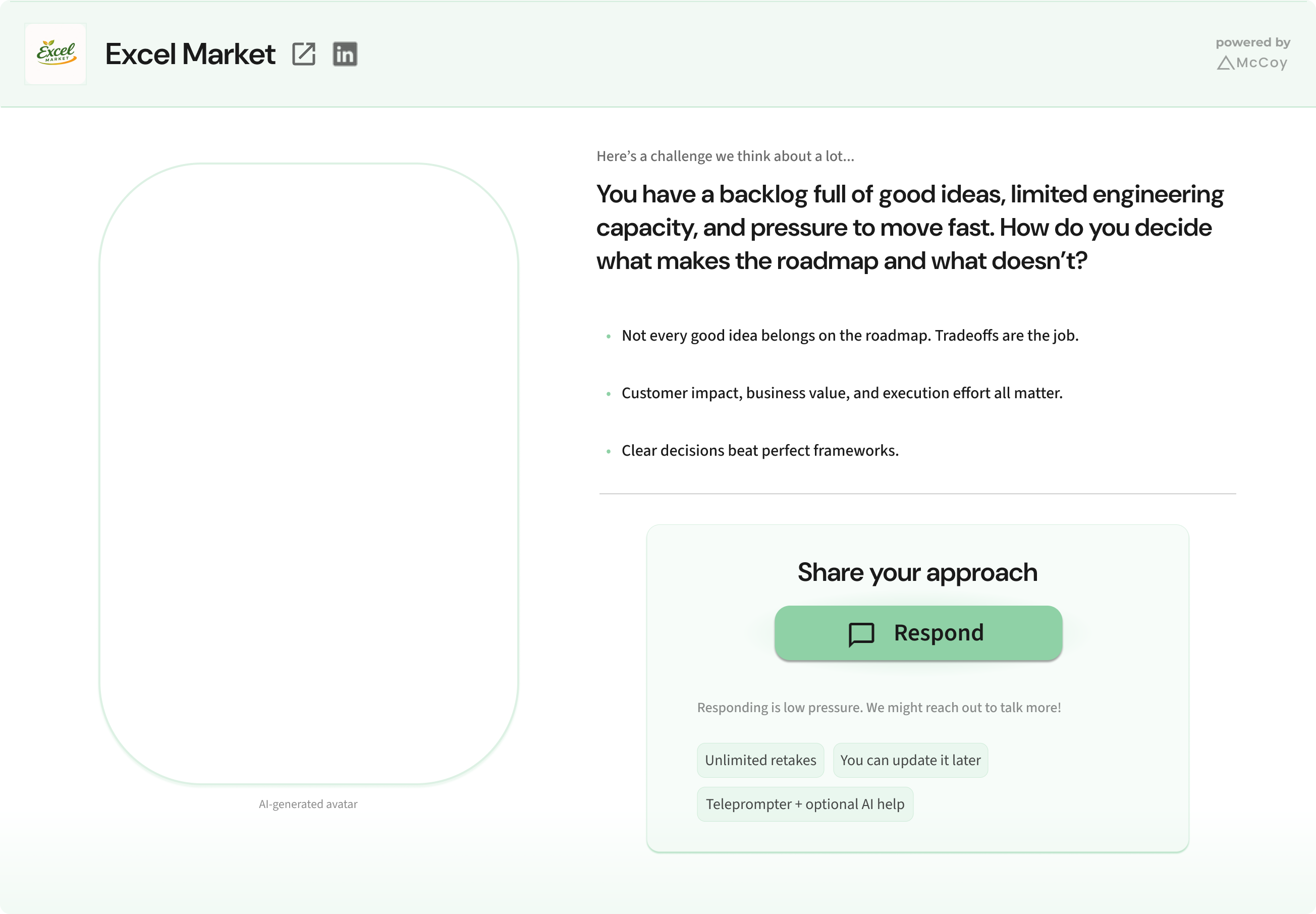
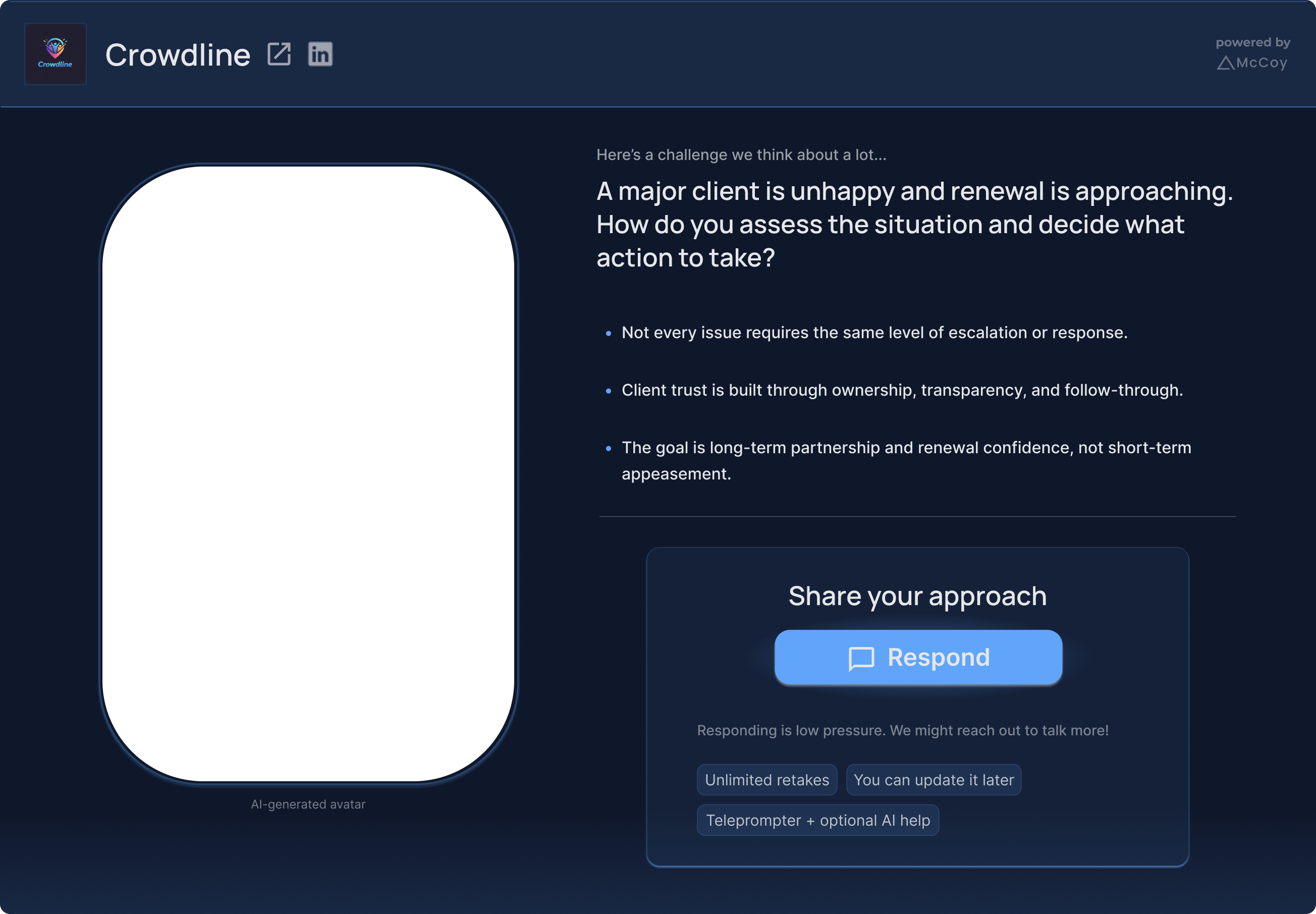
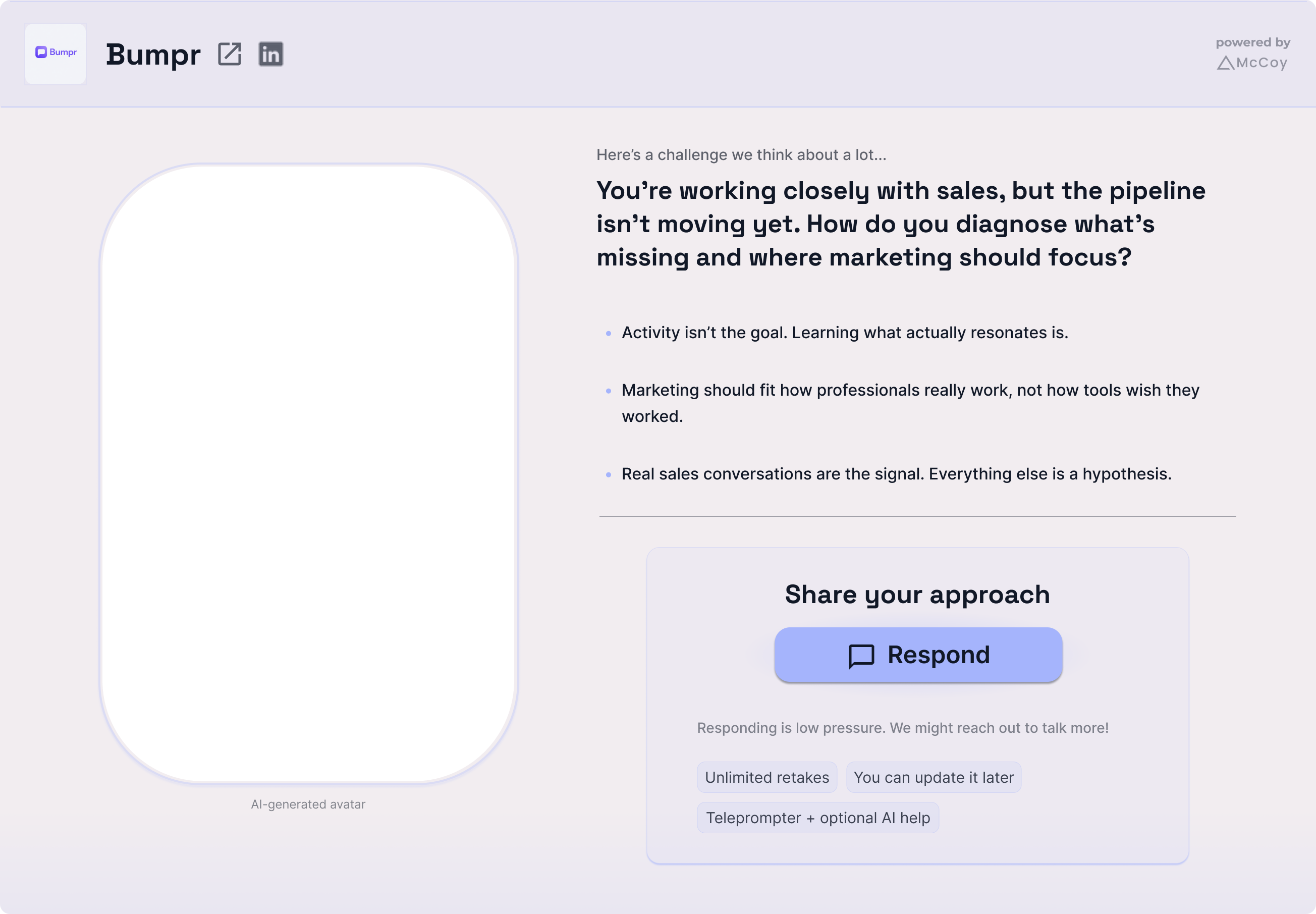
Some roles just
take up all your time
The problem
Some roles just
Some roles just
take up all your time
Why
Bots apply. Cheap tools auto-apply on behalf of candidates. AI writes the answers. None of it tells you who actually wants the job.
What it means
Hours of screens to find the people you want to keep talking to. And when someone sounds great, getting your hiring team or client to see what you see can take another round of work.
Your choice
Give candidates a real question from the role before the first call. Watch their responses on your time, choose who to call, and share the ones you want someone else to meet.
Bots apply. Cheap tools auto-apply on behalf of candidates. AI writes the answers. None of it tells you who actually wants the job. And when someone sounds great, getting your hiring team or client to see what you see takes even more time.
McCoy IQ amplifies real candidates.
Give candidates a real question from the role before the first call. Watch their responses on your time, choose who to call, and share the ones you want someone else to meet.
Every application is a door you have to open.
The real signal
The qualities that matter most
Thought process
Judgment
Taste
Approach to problem solving
How they use AI
A resume won’t show you any of this. One to five minutes of someone talking through a real problem will. And you can watch it before you spend an hour on a call.
More than a video
Candidates use a mobile app,
so you know it’s not a bot
Candidates record in the McCoy app, on their phone or tablet’s own camera. Because the recording happens inside the app, there are two signals you can check before you book an interview.
How it’s recorded
No virtual camera
Most deepfakes rely on a virtual camera, software that intercepts the video feed, edits it, and presents the result as if it came from a webcam. Virtual cameras only run on a computer, never on a phone or tablet. A native iOS or Android app that you download from the Apple or Play stores records straight from the device’s camera.
How virtual cameras and deepfakes actually workWhere it’s recorded
A country, not just an IP
Candidates can choose to share the country they recorded in. The country comes from the device’s GPS and appears next to the response. A VPN can make an IP address look like it’s anywhere, but a GPS location is much harder to fake.
How location fraud works in remote hiringCandidate experience
A challenge candidates actually enjoy
Low-pressure, and they’re never doing it cold. McCoy AI helps them prepare, retakes are unlimited, and they own the response, submitting only when they’re happy with it. Recording takes about 5 minutes, with roughly 15 of guided prep before it, and candidates say it’s fast and easy.
And no, the app isn’t a hurdle. Tap the link, install, and the challenge opens right away.


AI slop
Won’t the responses just be AI slop?
No. McCoy is built to draw out real substance that you can’t fake on camera.
McCoy AI probes for substance
McCoy AI asks the candidate questions to get at the substance your question is really testing for. A lived experience, a call they made and what it cost, something they built on their own.
Slop has nowhere to hide on camera
A generic answer with no specifics is obvious in a minute of video.
The challenge does the filtering
A good challenge tests for something that AI can’t answer without making something up.
Our stance on AI
AI for the work.
People for the decision.
When a posting draws thousands of applications, the question is who gets your time. Some vendors answer with an AI interview or a score. We answer with a challenge. You watch the responses and decide.
Faster work, not fewer decisions
McCoy drafts your challenge from the job posting, and McCoy AI helps candidates prepare, so the responses you get back are substantive and short enough to review in minutes.
No scoring, ranking, or summaries
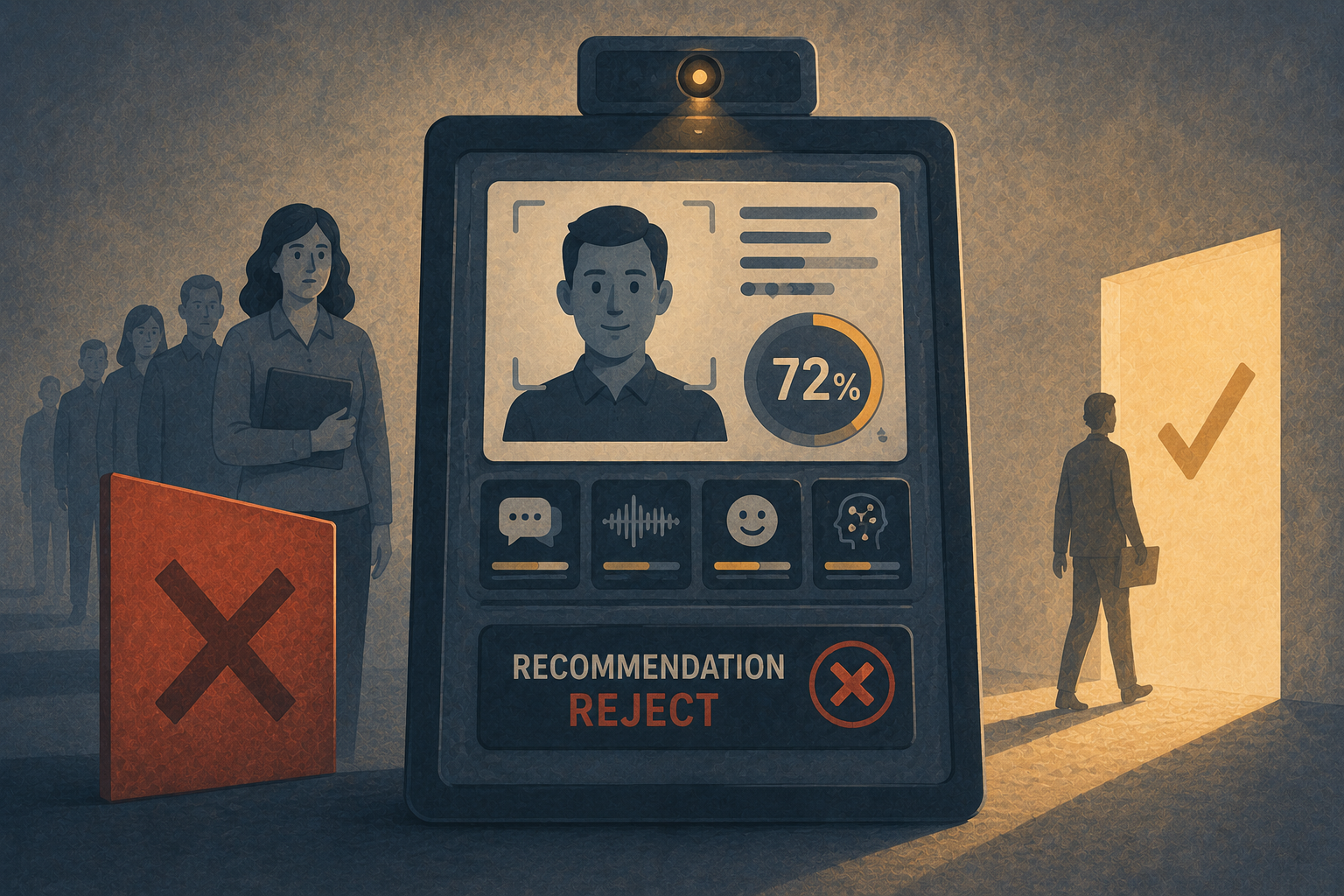
Automated decision-making (ADM) in hiring is drawing lawsuits and regulation. McCoy IQ gives you nothing to audit. There is no score, ranking, or AI summary between you and a candidate’s response.
Built to help you close
Send the hiring manager a response with your recommendation, or invite them in and choose which candidates they see. Hearing someone think makes your shortlist an easier sell.
What would you rather have before the phone screen?
Four ways to run the step between the resume and the interview.
Resume alone
- ✕Hundreds of AI-polished applications that read the same
- ✕No way to tell who is real or genuinely interested
- ✕Phone screens in batches, good people slip through
Resume + AI scoring
- ✕Opaque and inconsistent scoring
- ✕Error-prone and easily gamed
- ✕Drawing regulation and litigation
Resume + AI interviews
- ✕Long recordings you still have to review
- ✕An experience that makes candidates walk out
- ✕Open questions on where recordings go
Resume + McCoy IQ
- ✓Short responses you review in minutes
- ✓Candidates own their content
- ✓An experience candidates actually finish
The evolving AI regulatory landscape
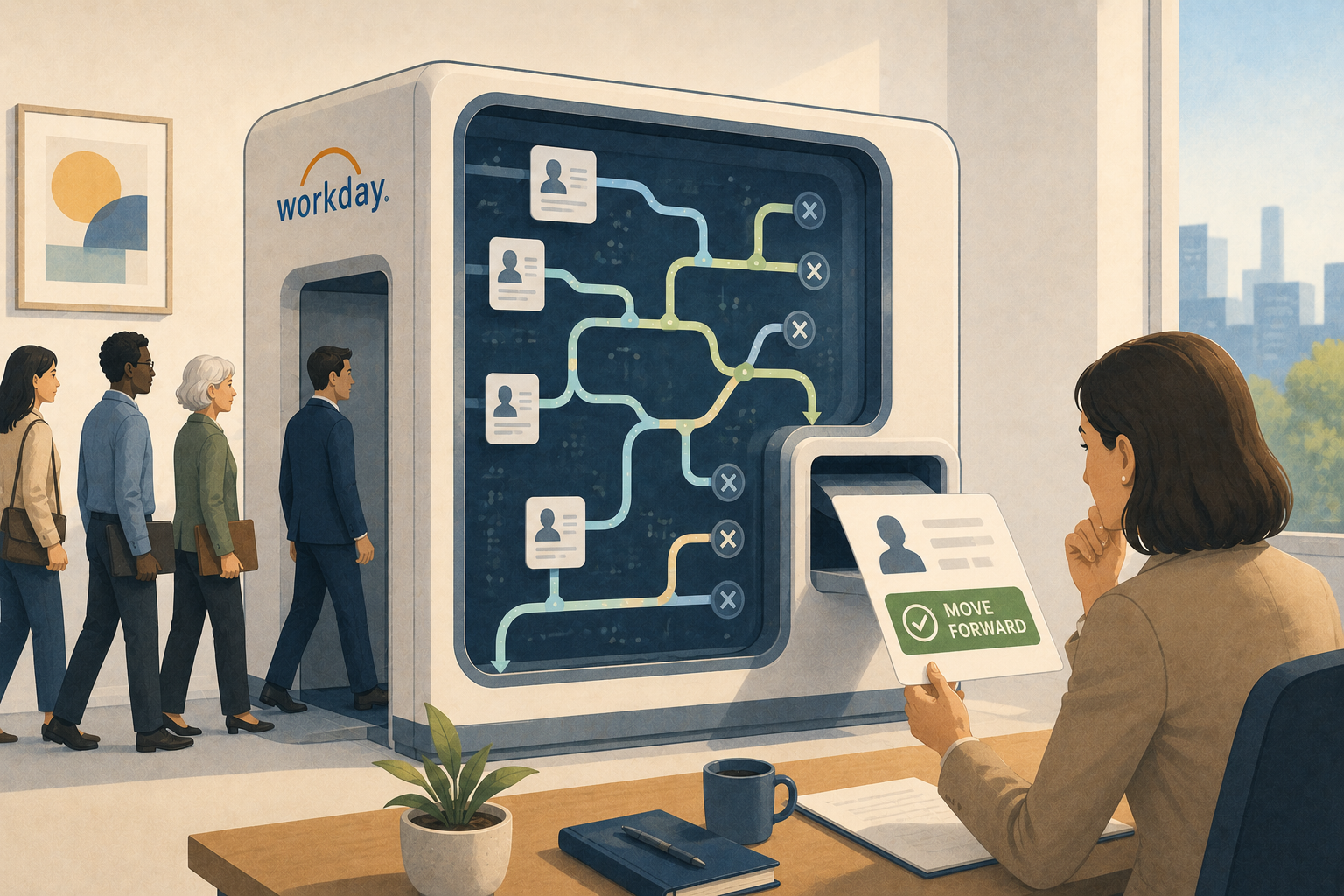

Works with your ATS
Already have an ATS? Works alongside it.
No replacement, no integration. Just a URL you send from the screening email you already send. Want a native integration for yours? Tell us which one.
Try it with your roles first, without ATS integration.
Most recruiters want to see McCoy IQ work with real candidates before committing to an ATS integration. So it runs alongside your ATS from day one. Send candidates the challenge, review responses in McCoy IQ, and move the ones you like forward.
Ready for a native integration? Tell us which ATS.

Free tool
See who is actually hiring
Watch hiring trends and posted compensation across novel AI jobs, the Forbes AI 50 and Cloud 100, B2B SaaS, and major law firms. Live data from company career sites, updated daily, no account needed.
From the blog
Recent stories

The category
The World Economic Forum calls this Trace Hiring
Seeing how a candidate thinks through a real problem, before the interview. McCoy IQ is the first platform built for Trace Hiring.
Read the Trace Hiring guideChoose your way in
Three ways to get a feel for McCoy IQ. Pick whichever suits how you like to evaluate tools.
Try it on your role
Paste one of your job postings below and watch a sample challenge take shape. No signup.
Read the Trace Hiring guide
What trace hiring is, why it works, and how to run it on your next role in minutes.
Try McCoy IQ with your applicants
30 days free on a real role. No credit card, no ATS integration.
FAQS
You've likely got a few questions
About McCoy IQ
A short video challenge you send to candidates so you can see how they think about a real problem from the role before deciding who to interview. Candidates respond in a few minutes from their phone. You review the responses in the McCoy IQ portal. It's a challenge, not an interview, ATS, or personality test. To see what one looks like, try generating one from a job description.
Yes. Because it's framed around a real business problem, candidates see it as a chance to demonstrate their thinking, not a hoop to jump through. The format is guided and low-pressure. Recording takes about 5 minutes, plus another 15 of guided prep with McCoy AI, and respondents say it's fast and easy. Early testing shows strong completion rates, especially among high-intent candidates who want to stand out.
No. McCoy IQ works alongside resumes. It adds a layer of signal that resumes can't provide. It shows how someone thinks, communicates, and approaches problems. It helps you make better decisions with the information you already have.
No. McCoy IQ is a challenge, not a formal interview. It sits between resume review and your first live conversation. Think of it as a way to see how someone approaches real work before deciding who's worth interviewing, without the scheduling overhead of a live call.
Most often in the middle, as the challenge between the resume and the phone screen. Recruiters call that step a pre-screen or a candidate assessment. You read the resumes, keep the maybes, and send them the challenge, so the only responses you watch come from people you were already considering.
It also works earlier in the funnel. Some teams put the challenge in the application itself, for roles where the resume says little. Others run a standing challenge before a role opens, so interested people can respond and there are warm options in hand when it is time to hire. The one thing McCoy IQ is not is the interview.
It also works earlier in the funnel. Some teams put the challenge in the application itself, for roles where the resume says little. Others run a standing challenge before a role opens, so interested people can respond and there are warm options in hand when it is time to hire. The one thing McCoy IQ is not is the interview.
It's much harder than on the desktop and browser tools in the news. Those deepfakes rely on a virtual camera, software that feeds a fake video into a browser or desktop as if it came from a real webcam. McCoy candidates record in our native iOS or Android app, on the phone or tablet's own camera, where a virtual camera has nowhere to run. No solution is foolproof, but it takes the most common way to do a deepfake off the table.
They can hide it with a VPN, which swaps their IP address to look like another country for a few dollars a month. A VPN can't touch GPS, though. When a candidate chooses to share their location, McCoy reads it from the device's GPS and shows you the country they recorded in, so an IP in one place and a recording in another is easy to spot. It's optional and country-level, and like any signal it's a flag to look into, not proof on its own.
A lot of async video tools were built like a cold interview: get on camera, timer running, one shot at each answer. That’s a different product for a different purpose, and it burned a lot of recruiters.
McCoy IQ isn’t that. Candidates take real time to think, prepare a script, use a teleprompter, and re-record as many times as they want before they share. You’re not measuring whether they crack under pressure. You’re seeing how they choose to communicate a story from their own experience.
The video is recorded directly through the candidate’s phone camera using our mobile app. You might reasonably wonder about privacy. Here’s the difference: the candidate owns the content they create in McCoy IQ. They can edit it or delete it after the fact, on their own terms. No other product in this space works that way.
McCoy IQ isn’t that. Candidates take real time to think, prepare a script, use a teleprompter, and re-record as many times as they want before they share. You’re not measuring whether they crack under pressure. You’re seeing how they choose to communicate a story from their own experience.
The video is recorded directly through the candidate’s phone camera using our mobile app. You might reasonably wonder about privacy. Here’s the difference: the candidate owns the content they create in McCoy IQ. They can edit it or delete it after the fact, on their own terms. No other product in this space works that way.
After your initial resume review, send your "maybe" pile a McCoy IQ challenge. Their video responses will show you how they think and communicate, enough to move confidently to a yes or no. It replaces the guesswork and extra phone screens that slow things down.
Share your challenge page link directly in LinkedIn outreach messages. It gives candidates something concrete to engage with instead of a cold pitch. It's a great way to start a conversation and gauge interest before scheduling calls.
Quiet hiring is when you source and engage candidates without a formal job posting. McCoy IQ supports this by letting you lead with a real business problem rather than a job description. You can share challenges in sourcing or social to start conversations even before there's a specific role or level attached.
Every candidate sees the same challenge and has the same opportunity to respond. The format is standardized, which creates a more level playing field than unstructured resume reviews or ad-hoc phone screens. Candidates can also retake their responses, so they're showing their best work. For more on how we built McCoy IQ around authenticity, see our approach.
Bias & AI
We address this in two ways.
On the candidate side: McCoy AI probes each candidate with a series of questions about their experience, and then gives them a chance to refine their answer to make it their own, in their own voice, from their own experience. How they choose to answer, what they focus on, and how they connect it to what they’ve done is itself a signal about who they are.
On your side: The response you get back is only as good as the challenge you set. The more you tell McCoy IQ about what you’re looking for in the role, the better we can help you craft a challenge that draws out real substance, like actual examples from the candidate’s experience. We’ve put a lot of effort into making sure what you see back is a valuable data point.
On the candidate side: McCoy AI probes each candidate with a series of questions about their experience, and then gives them a chance to refine their answer to make it their own, in their own voice, from their own experience. How they choose to answer, what they focus on, and how they connect it to what they’ve done is itself a signal about who they are.
On your side: The response you get back is only as good as the challenge you set. The more you tell McCoy IQ about what you’re looking for in the role, the better we can help you craft a challenge that draws out real substance, like actual examples from the candidate’s experience. We’ve put a lot of effort into making sure what you see back is a valuable data point.
It will happen sometimes. McCoy gives candidates tools to help them respond, and the effort still varies from one response to the next. A generic answer with no specifics shows in the first minute of video, the same way a thin resume shows in the first paragraph.
Treat it as a signal like any other. You’ve learned something about how that candidate approaches work, and it cost you a minute instead of a phone screen. The prep questions and a challenge that asks for real experience make it rarer, but the judgment stays with you.
Treat it as a signal like any other. You’ve learned something about how that candidate approaches work, and it cost you a minute instead of a phone screen. The prep questions and a challenge that asks for real experience make it rarer, but the judgment stays with you.
Every candidate sees the same challenge and has the same opportunity to respond. The format is standardized, which creates a more level playing field than unstructured resume reviews or ad-hoc phone screens. Candidates can also retake their responses, so they’re showing their best work. For more on how we built McCoy IQ around authenticity, see our approach.
No. McCoy IQ doesn’t score, rank, or grade responses. It gives you a video to watch and lets you decide who to call. The recruiter always makes the call.
We built it this way on purpose. Automated scoring of candidate videos raises real legal and bias questions (there’s active litigation right now against tools that do it), and we think the recruiter needs to stay in the driver’s seat. McCoy IQ is a data point, not a decision.
We built it this way on purpose. Automated scoring of candidate videos raises real legal and bias questions (there’s active litigation right now against tools that do it), and we think the recruiter needs to stay in the driver’s seat. McCoy IQ is a data point, not a decision.
Those laws are aimed at tools that use AI to evaluate candidates, whether by scoring, ranking, or deciding who advances. McCoy IQ does none of that. A person watches each response and makes the call, and we built it that way on purpose.
Your own hiring process may still carry obligations under state and city rules, such as notices to candidates, so check how you use McCoy IQ with your counsel.
Your own hiring process may still carry obligations under state and city rules, such as notices to candidates, so check how you use McCoy IQ with your counsel.
If you want to keep your first-pass review anonymous, send the challenge after it. Candidates go through your blind review first, then get the challenge only after they’ve cleared it. Your first-pass anonymity stays exactly as it is.
On the McCoy IQ side, you see the candidate as they chose to present themselves in their response. How you use McCoy IQ beyond that is up to you.
On the McCoy IQ side, you see the candidate as they chose to present themselves in their response. How you use McCoy IQ beyond that is up to you.
Even well-trained recruiters can make snap judgments during resume review, on things like names, schools, GPAs, gaps in employment, unfamiliar company names, or unusual career paths. Those signals don’t always predict how good a candidate would be at the actual work.
McCoy IQ gives you a different signal to weigh: how the candidate thinks and communicates about a real problem, in their own voice. When you’re deciding who’s worth a call, you’re not working from the resume alone.
McCoy IQ gives you a different signal to weigh: how the candidate thinks and communicates about a real problem, in their own voice. When you’re deciding who’s worth a call, you’re not working from the resume alone.
Use cases
Yes. About 40% of candidates respond to a McCoy IQ challenge, and recruiters use those responders as their phone-screen shortlist rather than working through the whole applicant pile. Because it’s framed around a real business problem, candidates see it as a chance to demonstrate their thinking, not a hoop to jump through. Recording takes about 5 minutes, plus another 15 of guided prep with McCoy AI, and respondents say it’s fast and easy.
Yes, in a few ways. First, you call fewer people: instead of running phone screens on everyone who cleared your resume review, you call the candidates who responded to the challenge. Second, the calls you do run are shorter and sharper, because you’ve already seen how the candidate thinks and communicates about a real problem. And when it’s time to bring in a hiring manager or other stakeholder, you can copy the response link and send. They can watch it on their own time.
After your initial resume review, send your "maybe" pile a McCoy IQ challenge. Their video responses will show you how they think and communicate, enough to move confidently to a yes or no. It replaces the guesswork and extra phone screens that slow things down.
Share your challenge page link directly in LinkedIn outreach messages. It gives candidates something concrete to engage with instead of a cold pitch. It’s a great way to start a conversation and gauge interest before scheduling calls.
Quiet hiring is when you source and engage candidates without a formal job posting. McCoy IQ supports this by letting you lead with a real business problem rather than a job description. You can share challenges in sourcing or social to start conversations even before there’s a specific role or level attached.
Using McCoy IQ
Minutes. Start with a job description, answer a few guided questions, and McCoy IQ helps draft the challenge, key highlights, and video script. Your branded challenge page is ready to share almost immediately.
No. You and your team work entirely in the McCoy IQ web portal. Create challenges, review responses, and manage your roster, all in the browser. The mobile app is for candidates: they tap your challenge link, install once, and respond from their phone camera.
No. McCoy IQ runs alongside your applicant tracking system (ATS). You create the challenge in McCoy IQ, paste the link into your ATS’s standard candidate email, and review responses in the McCoy portal. Nothing connects to your ATS, so the workflow is the same whether you’re on Greenhouse, Lever, Workday, or a spreadsheet.
Whoever owns the candidate pipeline. Most teams have a recruiter or hiring manager set up the challenge once, then share the link from wherever they normally communicate with candidates. Reviewing responses is also flexible. You can invite collaborators to a role and choose which responses each one can see.
Yes. The challenge page is fully branded with your colors, logo, and fonts (pulled automatically from your website), so it looks like part of your hiring flow, not a third-party tool. Candidates land on what looks like your page, not McCoy’s.
Getting set up
Minutes. Start with a job description, answer a few guided questions, and McCoy IQ helps draft the challenge, key highlights, and video script. Your branded challenge page is ready to share almost immediately.
No. You and your team work entirely in the McCoy IQ web portal. Create challenges, review responses, and manage your roster, all in the browser. The mobile app is for candidates: they tap your challenge link, install once, and respond from their phone camera.
No. McCoy IQ runs alongside your applicant tracking system (ATS). You create the challenge in McCoy IQ, paste the link into your ATS’s standard candidate email, and review responses in the McCoy portal. Nothing connects to your ATS, so the workflow is the same whether you’re on Greenhouse, Lever, Workday, or a spreadsheet.
Whoever owns the candidate pipeline. Most teams have a recruiter or hiring manager set up the challenge once, then share the link from wherever they normally communicate with candidates. Reviewing responses is also flexible. You can invite collaborators to a role and choose which responses each one can see.
Yes. The challenge page is fully branded with your colors, logo, and fonts (pulled automatically from your website), so it looks like part of your hiring flow, not a third-party tool. Candidates land on what looks like your page, not McCoy’s.
Your boss or team will probably ask the same questions any team asks: how easy is McCoy IQ to get started with, does it need an ATS integration, what happens to candidate data, how does it affect the existing hiring flow. We’ve answered most of those questions elsewhere in this FAQ.
If it helps to send something over, we can put together a one-pager tailored to your team so you don’t have to translate it yourself. And we’re happy to meet with your boss, your team, or whoever else needs to weigh in and answer questions directly. Email us at contact@mccoy.io.
If it helps to send something over, we can put together a one-pager tailored to your team so you don’t have to translate it yourself. And we’re happy to meet with your boss, your team, or whoever else needs to weigh in and answer questions directly. Email us at contact@mccoy.io.
For candidates
McCoy IQ offers a written-response accommodation. Candidates who can't or prefer not to record video can submit written answers instead. The goal is to see how someone thinks. The format is flexible.
No. AI avatars are only available to hiring teams, and only for the challenge intro video. All candidate responses are recorded live from their device camera in the McCoy mobile app. There's no way to upload pre-recorded or AI-generated video. That's what makes the signal real.
Yes. Alongside their video response, candidates can supplement with work samples, images, audio, PDFs, and links, anything that helps show their thinking. The main video is the core signal; the supporting materials add depth where useful.
Yes. Candidates can review, redo, and choose when to submit their response. They own their content and can retake recordings until they're satisfied. This ensures you're seeing their best effort, not a nervous first take.
Privacy & data
See our Privacy Policy for full details on what we collect, how it's used, retention, and candidate rights.